Is Astral Void More
Complex Than Chess?
Deckbuilding space, branching factor, and game-tree complexity — measured against the most studied game in history.
Yes. And It Isn't Close.
By raw combinatorics, Astral Void is vastly larger than chess — in deckbuilding space, in branching factor, and in total game tree.
But "more combinations" and "deeper" are not the same claim, and the honest answer needs both halves. The numbers first; the caveat further down.
game tree
(Shannon number)
before a card is played
Deckbuilding: A Strategy Space Chess Does Not Have
A legal deck is exactly 40 cards, at most 3 copies of any one card, drawn from one faction or two allied factions on the Wheel. From a live pool of 592 collectible cards, that yields:
| Construction | Legal decks |
|---|---|
| Single faction (88 cards) | 1033 |
| Two allied factions (174) | 1043 |
| Whole-pool upper bound | 1063 |
| Shuffle orderings, one deck | 1048 |
Chess has no equivalent. Both players begin from an identical, fixed position, every game, forever. In Astral Void the first strategic decision is made before the match exists.
The Branching Factor Is the Real Gap
A chess player chooses among roughly 35 legal moves. An Astral Void turn is not one decision — it is a compound of them:
- Which cards to play, from a hand of up to ten
- In which order — sequencing changes what resolves and what survives
- At which targets, for every targeted effect
- Which units attack which defenders — a full assignment problem
- Whether to fire the Flagship Command, and on what
branching per turn
branching per move
forces an ending
That is roughly seven orders of magnitude more choice per turn. It is why the total tree (~10225) outruns chess (~10123) despite matches lasting a fraction as long.
Every Figure, Measured
| Measure | Astral Void | Chess |
|---|---|---|
| Opening position | 1043 decks | 1 (fixed) |
| Branching factor per decision | ~108.7 | ~35 |
| Game-tree complexity | ~10225 | ~10123 |
| Visible board state alone | ~1073 | ~1044 (total) |
| Hidden information | Yes — hand & deck | None |
| Randomness | Yes — 1048 shuffles | None |
| Guaranteed termination | Singularity 13 | 50-move rule |
| Evolving strategy space | Yes — metagame | Rules frozen |
It is the reason poker resisted machine mastery long after chess fell: you are not solving a position, you are playing a probability distribution over an opponent's hidden hand and your own draw.
The Hidden Hand Is the Easy Part
It is tempting to think the difficulty is the cards you can't see. It isn't. Delete every hidden card from the game — give both players perfect information — and what remains still dwarfs chess entirely.
on the board can occupy
nothing hidden counted
entire state space
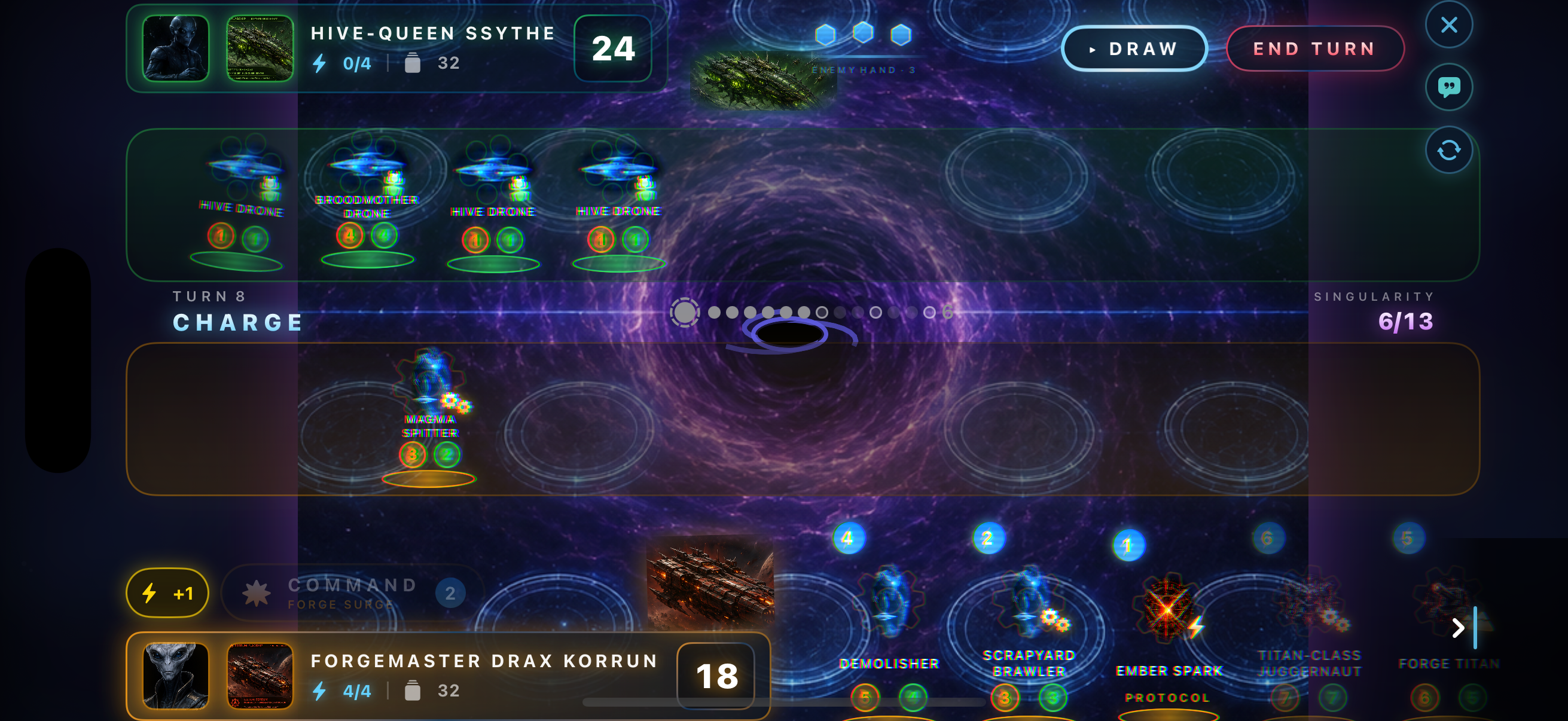
Every turn you are reading a position built from things both players can see:
- Their committed board — each unit's attack, damage taken, shields, keywords, and which of six status effects are riding on it
- Both hull totals — the race, and who can afford to trade
- Both energy curves — what they could deploy next turn, not just this one
- The Singularity — the shared clock that changes what all of it is worth
More Combinations Is Not the Same as Deeper
An analysis that only flattered the game would not be worth reading. So: chess is denser than Astral Void in per-decision depth, and that deserves saying plainly.
Chess's 10123 is entirely decision complexity. Perfect information, zero randomness — every position is a solvable puzzle, and skill expresses as pure calculation. Centuries of study have not exhausted it.
A meaningful share of Astral Void's raw count is a different substance:
- ~1048 is shuffle order — hidden, and largely inert beyond probability. It inflates the state count without adding proportional decision-making.
- ~1043 is deckbuilding — real strategy, but a different skill, exercised before the match begins.
Where It Genuinely Exceeds Chess
I. A harder class of problem. Chess is perfect-information and deterministic. Astral Void is neither. You play against a hidden hand and an unknown draw, which means every turn is a decision under uncertainty rather than a calculation toward a known board. Categorically harder to reason about — for humans and for machines.
II. A living metagame. Chess's rules are frozen. Astral Void's strategy space moves: eight factions, allied pairings on the Wheel, and a balance band that shifts as decks evolve. The optimal play today is not the optimal play next season — a second dimension of strategy that chess simply does not possess.
Astral Void asks: what is the best move, against a hand I cannot see, with a draw I cannot predict, in a metagame that changed last week?
Why It's More Fun Than Magic: The Gathering
Magic invented the genre and earned its place. But it was designed in 1993, for cardboard — and thirty years of accumulated rules are carried by every new player. Astral Void keeps what makes the genre great and discards the parts that were never fun.
◆ ASTRAL VOID
- Energy ramps automatically. Every turn you get more. You are never mana-screwed, never mana-flooded, never lose a game you didn't get to play.
- The Singularity ends it. A shared doom-clock counting to 13. No stalling, no draws, no forty-minute grind — every match resolves in fire.
- It's animated. Orbital strikes, venom ambushes, freeze bursts, flagship deaths. Your plays don't just resolve — they land.
- Turns take a minute. Async PvP means a full match fits in the gaps of a real day.
- Modern sci-fi. Shapeshifting reptilians, Nordic light-elves, a reverse-engineered human fleet — a universe built this decade, not in 1993.
- The whole set, free. No boosters. No chase rares. No secondary market.
◇ THE 1993 MODEL
- Lands are a card you draw. Mana screw and flood are the genre's oldest complaint — you can lose without ever getting to play.
- Games can stall out. Control mirrors, decking, draws — the ending is not guaranteed.
- Paper doesn't move. The spectacle lives in your imagination.
- Priority, the stack, state-based actions — a rules engine so deep it needs professional judges.
- Cost of entry. A competitive deck can cost more than a console.
- Rotation. The cards you bought stop being legal.
Figures computed directly from the shipping card database and engine constants. Chess baselines per Shannon (1950).